

ISABER
Darth Vader Lightsaber — Xenopixel V3 / Proffie 2.2 ESB Replica
Darth Vader Lightsaber — Xenopixel V3 / Proffie 2.2 ESB Replica
Couldn't load pickup availability
The black glove. The breathing. The red blade igniting in the dark. Darth Vader's lightsaber is the most recognized weapon in cinema. And the thing most people don't realize: his hilt design changed between films. The Empire Strikes Back (ESB) version — the one ISABER replicates — has a distinctive silver control box and black emitter section that differs from the A New Hope prop.
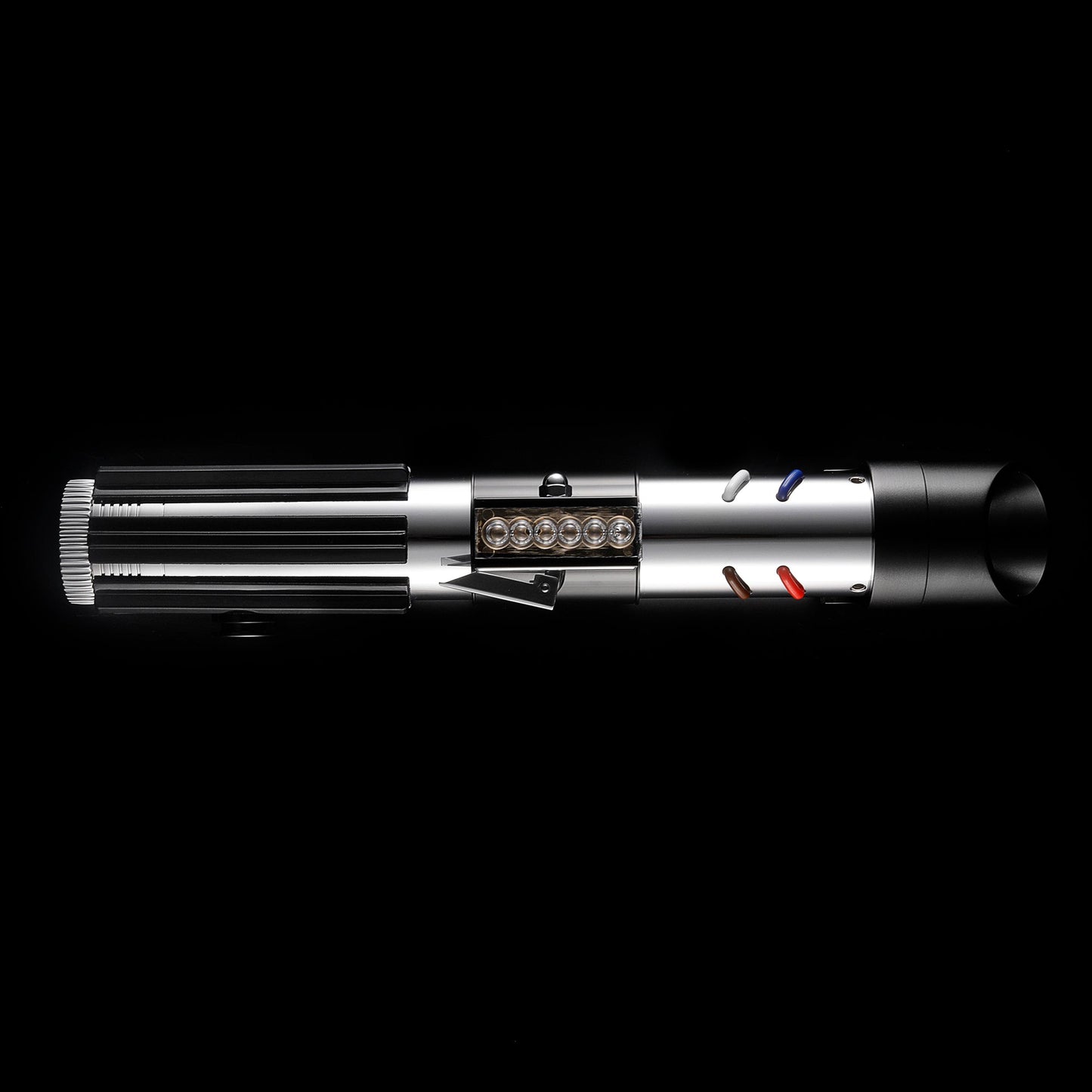
This is a 28cm alloy metal hilt with mirror-polished nickel-chrome plating and a black polymer grip. Available in Xenopixel V3 and Proffie 2.2, with a Neopixel blade in 32" or 36". Also available in RGB Baselit for heavy dueling.
Vader sabers are everywhere. What makes this one different? The ESB-accurate control box, the polished chrome that actually reflects light like the film prop, and three electronics tiers so you're not forced into one board. If you want a Vader saber you can duel with, display, or customize — not just look at — this is it.
ISABER is not associated with Lucasfilm or Disney. This is a sabersmith-built replica for dueling, cosplay, or display.
What Are the Specifications?
| Specification | RGB & Baselit | Xenopixel V3 | Proffie 2.2 |
|---|---|---|---|
| Character | Darth Vader (ESB style) | ||
| Hilt Material | Alloy metal, mirror-polished nickel-chrome plating | ||
| Grip | Black polymer grip texture, three-band pattern | ||
| Hilt Length | 28cm | ||
| Blade Type | 2mm polycarbonate (in-hilt LED) | 3mm polycarbonate (Neopixel LED strip) | |
| Blade Length | 32" (82cm) or 36" (92cm) | ||
| LED Power | 12W RGB (in hilt) | 50W Neopixel strip (in blade) | |
| Sound Fonts | 30+ pre-installed | 34 pre-installed | 16–35 pre-installed |
| Smooth Swing | Yes | ||
| Ignition | On/off | 10 styles | Fully programmable |
| Bluetooth | Yes | Yes (XenoConfigurator app) | No (USB config) |
| Battery | 18650 3000mAh | 18650 3600mAh | |
| Battery Life | 3–5 hours | ||
| Dueling | Heavy contact | Light to medium | |
| Charging | USB-C | ||
The ESB design is the one most fans picture. Silver control box on the side. Black emitter section with ventilation grooves. Black polymer grip in three bands. The A New Hope version had a different control box and lacked the polished finish. If screen accuracy to the original trilogy matters, the ESB hilt is the one.
Soundboard Options
Three boards. Same hilt. Very different experience.
RGB & Baselit — Built for Battle
This is the dueling choice. The LED is in the hilt, shining through a hollow 2mm polycarbonate blade. No electronics in the blade to break. Full-contact sparring? No problem.
- 12W RGB LED in the hilt — bright, durable, simple
- 30+ sound fonts on SD card
- Gesture control, smooth swing, flash on clash, blaster block
- Bluetooth app for color and font changes
- 2mm blade takes heavy punishment
The trade-off: no scrolling ignition. The blade is either on or off. If the screen-accurate ignition animation matters to you, go Xenopixel.
Xenopixel V3 — The All-Rounder
This is what most Vader buyers pick. Full Neopixel experience, no config files.
- 50W Neopixel LED strip inside a 3mm blade — scrolling ignition, even brightness
- 34 pre-installed sound fonts, 9 blade effects, 7 ignition styles
- Bluetooth app (iOS & Android) — switch colors, fonts, effects from your phone
- Full gesture set: smooth swing, clash, tip drag, stab, blaster, melt, lock-up
Open the box. Charge it. Duel tonight. That's the Xenopixel experience.
Proffie 2.2 — Total Control
For the tinkerer. Open-source. Unlimited customization. No app — you edit config files on the SD card. Arduino IDE for firmware.
- Same 50W Neopixel hardware as Xenopixel
- Design your own ignition animations frame by frame
- Unlimited blade styles, custom sound font mixing, per-pixel RGB control
- 16–35 pre-installed fonts, unlimited via SD expansion
Never touched Arduino? Go Xenopixel. Already have a Proffie saber and love config editing? You already know.
Design Features
The ESB Hilt: More Than a Black Tube
Vader's hilt looks simple from a distance. Up close, it's anything but. The mirror-polished nickel-chrome plating gives it a reflective, almost liquid-metal finish — not the matte black some budget replicas use. The silver control box sits on one side with two rectangular activation switches, exactly as it appears on screen.
The black emitter section has accurate ventilation grooves. The grip uses black textured polymer in three bands — the same pattern as the ESB screen-used prop. At 28cm, it's compact enough for one-handed use but has enough weight to feel substantial in hand.
Blade Options
Two thicknesses. Two purposes. 2mm (RGB Baselit) for heavy dueling — takes full-contact strikes without complaint. 3mm (Xenopixel/Proffie) for the Neopixel experience — scrolling ignition, even brightness, blade effects that make the red blade look alive.
Both are standard 1-inch diameter polycarbonate. Removable, replaceable, cross-compatible. The 32" length gives balanced handling. The 36" gives Vader's imposing reach.
Who Was Darth Vader — and Why Does His Lightsaber Matter?
Darth Vader. Formerly Anakin Skywalker. The Chosen One who fell. Trained by Obi-Wan Kenobi. Seduced by Palpatine. Rebuilt inside a black suit after Mustafar. The most iconic villain in film history.
His lightsaber tells that story. After losing his Jedi weapon to Obi-Wan on Mustafar, Vader built a new one — the red-bladed Sith weapon that would terrorize the galaxy for two decades. Unlike his Jedi saber (a Graflex-style hilt passed down to Luke), Vader's Sith hilt was custom. Sleeker. Darker. Built for a cybernetic hand that never tired.
Vader's dueling record is a list of the saga's defining moments:
- Mustafar (Revenge of the Sith) — The duel that ended Anakin Skywalker. Lost to Obi-Wan. Rebuilt as Vader.
- Death Star corridor (A New Hope) — The first time the galaxy saw a red lightsaber in action. Fought Obi-Wan one last time.
- Cloud City (Empire Strikes Back) — "I am your father." Defeated Luke, took his hand. The most famous lightsaber duel in cinema.
- Death Star II (Return of the Jedi) — Redeemed. Turned on Palpatine. Died as Anakin Skywalker.
Where Did Vader's Red Lightsaber Come From?
After losing his Jedi weapon to Obi-Wan on Mustafar, Vader needed a new blade. The Sith way to get one isn't to build from scratch — it's to take one and corrupt it.
Palpatine sent Vader to kill Jedi Master Kirak Infil'a, a warrior monk who had taken a vow not to engage in the Clone Wars. Vader tracked him to the river moon of Al'doleem, defeated him in combat, and took his green-bladed lightsaber. Then came the ritual: on Mustafar — the same planet where he lost his limbs, his love, and his old life — Vader poured his rage, pain, and hatred into the captured kyber crystal. The crystal bled. Turned from green to red. The Sith ritual of bleeding a kyber crystal makes it serve the dark side by force, and Vader's was one of the most violent bleedings in canon.
Why Mustafar? Palpatine chose the location deliberately. Making Vader confront the site of his greatest failure — and channel that into the crystal — produced a weapon bonded to its wielder's suffering. The red blade that emerged was more than a color. It was a scar.
How Vader Modified His Lightsaber for the Suit
Vader's cybernetic hands and armored suit changed everything about how he interacted with a lightsaber. Fine motor control was gone. The suit's gloves were thick. The helmet's peripheral vision was limited. So the hilt had to adapt.
- Enlarged activation controls. The switches were repositioned and made larger — Vader had to be able to ignite the blade by feel through armored gloves.
- Reinforced outer casing. The hilt was built tougher than a standard lightsaber. Vader's Djem So style channeled massive force through the grip — a standard hilt could deform under his cybernetic grip strength.
- Electromagnetic shielding. The suit's life support systems and cybernetic interfaces generated interference. The hilt needed shielding to prevent electrical noise from destabilizing the blade.
- Dual-phase function. Vader's hilt could adjust blade length mid-combat — extending or retracting the blade to surprise opponents or adapt to confined spaces. This was a feature he used sparingly but effectively, most notably in tight-quarters combat where a standard-length blade would strike walls or bulkheads.
The result was a weapon as unique as the man who carried it. Not elegant like Dooku's. Not acrobatic like Maul's. A heavy, industrial, unbreakable instrument of power — built for a cybernetic hand that never tired and never let go.
Vader's Fighting Style: Djem So, the Dominator's Form
Vader didn't fight like Dooku. Dooku was a fencer — precise, economical, one-handed. Vader was a battering ram.
His form was Djem So (Form V) — the power-based variant of Shien. Where Makashi (Dooku's Form II) prizes precision and point control, Djem So prizes overwhelming force. Two-handed strikes meant to break through guards through sheer power. Vader's cybernetic strength gave him an edge no organic duelist could match — he could deliver strikes that would shatter the wrist of a normal opponent.
But Vader wasn't just a brute. After Mustafar, he adapted. The heavy suit limited his mobility, so he refined Djem So into a tighter, more efficient version. Economy of motion born of necessity. He couldn't match the acrobatics of his Jedi self, so he became a wall. Impenetrable defense. Devastating counter-strikes. Every duel against Vader was a countdown — his opponent had to win quickly, because Vader never tired.
How Vader's Lightsaber Compares to Other Iconic Sabers
| Character | Hilt Shape | Combat Form | Fighting Style | Best For |
|---|---|---|---|---|
| Darth Vader | Straight, polished | Djem So (Form V) | Two-handed power, relentless pressure | Dominant dueling, intimidation |
| Count Dooku | Curved | Makashi (Form II) | One-handed, precision dueling | Fencing, point control |
| Kylo Ren | Straight, crossguard | Self-taught | Heavy, raw, emotional | Crossguard aesthetic |
| Darth Maul | Straight, double-blade | Juyo (Form VII) | Aggressive, spinning | Multiple opponents, flow arts |
| Anakin Skywalker | Straight, Graflex | Djem So (Form V) | Two-handed, athletic power | Aggressive dueling |
| Obi-Wan Kenobi | Straight, thin-neck | Soresu (Form III) | Defensive, efficient | Defensive dueling |
| Luke Skywalker | Straight, Graflex/ROTJ | Djem So/self-taught | Raw to refined | Classic hero display |
Here's the thing. Vader's hilt looks similar to Anakin's and Luke's from a distance — straight metal tube, black accents, red or blue blade. But up close, they're completely different props. Anakin's Graflex is a converted camera flash handle. Vader's ESB hilt is a custom-machined design with a distinctive control box. If you collect character replicas, the difference is night and day. Vader's hilt is heavier, more imposing, more finished — a Sith Lord's weapon, not a Jedi's tool.
Behind the Scenes: The Real-World Lightsaber Prop
The Vader lightsaber prop is a piece of film history built from found objects. The original A New Hope hilt was an MPP Microflash — a vintage camera flash unit from the 1950s. The prop team added rubber T-tracks (actually cabinet door bumpers from a hardware store), calculator parts, and plumbing fittings. The result looked industrial, functional, and menacing — a perfect fit for Vader.
For The Empire Strikes Back, the prop was refined. A second MPP Microflash was used, with minor modifications: the control box gained the distinctive silver finish that defines the ESB design, and the grip section was slightly reworked. This is the version the ISABER replica is based on — the one Vader held when he told Luke the truth on Cloud City.
David Prowse, a 6'6" British bodybuilder, wore the suit and performed the lightsaber choreography. James Earl Jones provided the voice. The combination — Prowse's physical presence, Jones's bass-baritone — created something neither could achieve alone.
And the "I am your father" line? Prowse was never told. The script handed to him on set had Vader saying "Obi-Wan killed your father." Only Hamill, Lucas, and a few crew members knew the real line. Jones recorded it later in a sound booth. Prowse found out at the premiere, along with everyone else in the theater.
What Happened to Vader's Lightsaber After Return of the Jedi?
Vader's final act was throwing Palpatine down the Death Star reactor shaft. Seconds later, the Death Star II exploded, taking Vader's body — and his lightsaber — with it. In the current canon, the lightsaber was lost in the destruction of the second Death Star.
But the story might not end there. In Chuck Wendig's Aftermath trilogy, a cult known as the Acolytes of the Beyond — dark side worshippers who believed Vader was a martyr — claimed to possess and ritually destroy what they believed was Vader's lightsaber. Whether it was genuine or a fake is deliberately ambiguous. The cult's leader wore a red lightsaber crystal around her neck, claiming it belonged to Vader. After the ritual destruction, the fragments were scattered.
Either way, Vader's lightsaber legacy didn't end with the Empire. It became a relic — a symbol of fear, power, and ultimately, redemption.
What Vader's Lightsaber Represents
The red blade is the obvious symbol. Sith. Dark side. Fear. But Vader's lightsaber carries weight that other red blades don't.
It's a weapon built from loss. The crystal was taken from a Jedi Vader murdered. It was bled on the planet where he lost everything. Every time he ignited it, he was reminded of what he gave up to become what he was. The heavy, industrial hilt — oversized controls for armored gloves, reinforced casing for cybernetic grip strength — is a constant reminder that the man inside the suit is barely alive.
And yet. In his final moments, Vader used that same red blade to kill the Emperor and save his son. The weapon of a Sith Lord, turned to an act of love. That's why Vader's lightsaber matters more than any other red blade in Star Wars. It's not just the weapon of a villain. It's the weapon of someone who came back.
Pricing & Configurations
| Configuration | ISABER Price |
|---|---|
| RGB Baselit + 28"/32"/36" Blade | $425 |
| Xenopixel V3 + 28"/32"/36" Blade | $549 |
| Proffie 2.2 + 28"/32"/36" Blade | $609 |
All three blade lengths are the same price. Hilt, blade, battery, USB-C cable, display stand, blade plug, hardware kit, manual, and premium case included with every configuration. Xenopixel version also includes an SD card reader.
When Should You Choose (and NOT Choose) the Vader Lightsaber?
Get this saber if:
- You want the most iconic red blade in Star Wars. Vader's saber is the original. The one that defined what a Sith weapon looks like. Conventions, photos, display — people recognize this hilt instantly.
- You duel with power, not finesse. Djem So is built for two-handed dominance. If your fighting style is aggressive, heavy strikes, and relentless pressure, Vader's hilt matches how you fight.
- You're cosplaying Vader and screen accuracy matters. The ESB hilt with the silver control box and polished chrome is the version most fans consider definitive. The RGB Baselit version handles the heavy contact convention dueling demands.
- You collect Sith Lords. Vader belongs next to Maul, Dooku, Kylo Ren, and Sidious on your shelf. The mirror-polished chrome catches light in a way matte black hilts don't.
Skip this saber if:
- You want a unique, conversation-piece hilt. Vader's hilt is iconic, but it's a straight metal tube with black accents — the most common saber silhouette. If you want something that stands out on a belt, Dooku's curved hilt or Kylo's crossguard draws more questions.
- You primarily spin and flow. Vader's hilt is 28cm of polished metal with a control box on one side. It's not balanced for continuous spinning. Maul's double-blade or a lighter single-blade hilt is better for flow arts.
- You want the lightest possible duel saber. The metal alloy construction has heft — that's part of why it feels premium, but if you want a featherweight dueling tool, there are lighter hilts.
- Your budget is tight and Vader isn't your #1 character. Premium Vader replicas exist at every price point. If you're choosing between characters, pick the one that means the most to you.
What's in the Box?
- Darth Vader ESB-style hilt with installed soundboard and rechargeable battery
- 1-inch polycarbonate blade (your choice: 32" or 36")
- USB-C charging cable
- Display stand
- Blade plug
- Allen key and spare screw set
- User manual
Frequently Asked Questions
Q1: Which version should I choose — RGB, Xenopixel, or Proffie?
A: RGB Baselit for heavy dueling on a budget. No electronics in the blade — full-contact sparring, no worries. Xenopixel V3 for the full Neopixel experience without config files. Bluetooth app, scrolling ignition, 34 fonts. This is what most Vader buyers pick. Proffie 2.2 for unlimited customization — design your own ignition animations and blade effects. But you'll live in Arduino IDE.
Q2: Can I duel with this lightsaber?
A: RGB Baselit = yes, heavy contact. The LED is in the hilt, blade is just a polycarbonate tube. Xenopixel/Proffie = light to medium only. The LED strip inside can crack from hard impacts. For competitive dueling, get the RGB version. For cosplay sparring and backyard practice, Xenopixel holds up fine.
Q3: Is this screen-accurate to the movies?
A: Based on the Empire Strikes Back (ESB) design — the most recognized Vader hilt. Silver control box with two activation switches, black emitter with ventilation grooves, three-band polymer grip. Not a 1:1 licensed replica, but the ESB silhouette is accurate where it counts. The mirror-polished chrome catches light like the screen-used prop.
Q4: How is this different from Anakin's lightsaber?
A: Vader's Sith hilt is a completely different design from Anakin's Jedi Graflex. Anakin's is a converted camera flash handle — thinner, lighter, with a clamp and bubble strip. Vader's is a custom-machined design — heavier, polished chrome, with a side-mounted control box. They look nothing alike up close. Vader built this hilt after Mustafar. His old Graflex became Luke's.
Q5: Why does Vader's hilt have a control box on the side?
A: The ESB prop had a control box based on a vintage camera accessory. In-universe, it houses the blade length adjuster and power controls. In practice, it gives the hilt an asymmetrical, industrial look that suits Vader's mechanical aesthetic. It also means the hilt has a natural "front" side — the control box faces the opponent when you hold it in standard grip.
Q6: How long does the battery last?
A: 3–5 hours on a full charge. RGB uses a 3000mAh 18650. Xenopixel and Proffie use 3600mAh 18650s. Battery is replaceable — buy a spare for all-day convention use. USB-C charges to full in 2–3 hours.
Q7: Does it have smooth swing?
A: Yes. All three versions have gesture-controlled smooth swing. The board tracks real-time acceleration and pitch-bends the swing sound to match your speed. Faster swing, higher pitch. No gaps between idle hum and swing audio.
Q8: Can I add custom sound fonts?
A: Yes. All versions store fonts on SD card. Add .wav font folders from your computer. The community has thousands of free fonts — every Vader sound ever recorded, plus custom Sith fonts. Xenopixel and RGB let you manage fonts via Bluetooth app. Proffie requires SD card editing.
Q9: Is this the same hilt Vader uses in Rogue One and Obi-Wan Kenobi?
A: The Rogue One / Obi-Wan Kenobi hilt is slightly different — it's based on the A New Hope design with subtle modifications. The ISABER replica is the ESB version, which is the most recognized design and the one used in the iconic Cloud City duel. Most Vader collectors prefer the ESB hilt for its polished chrome finish and distinctive control box.
Q10: What blade length should I get?
A: 32" (82cm) for balanced handling. Fits most display stands. 36" (92cm) for Vader's imposing reach. If you're tall or want the most screen-accurate proportions, go 36". If you're unsure, 32" is the safer choice.
Q11: Does the Proffie version have Bluetooth?
A: No. Proffie is configured via USB cable and SD card editing. RGB and Xenopixel have Bluetooth app control (XenoConfigurator for iOS & Android). If you want to change colors from your phone, go Xenopixel.
Q12: Where did Vader get the kyber crystal for his red lightsaber?
A: He took it from Jedi Master Kirak Infil'a, a warrior monk he defeated on the river moon of Al'doleem. The crystal was originally green. Vader "bled" it on Mustafar — the Sith ritual of pouring dark side energy into a captured crystal until it turns red. The location was deliberate: the site of his greatest defeat, now the birthplace of his Sith weapon.
Q13: What happened to Vader's lightsaber after he died?
A: Presumed lost in the destruction of the second Death Star. In canon, it fell into the reactor shaft along with Palpatine moments before the station exploded. In the Aftermath novels, a dark side cult claimed to possess and destroy what they believed was Vader's lightsaber — whether it was real or fake is left ambiguous.
Q14: What's the warranty?
A: ISABER covers manufacturing defects on the hilt and electronics for 30 days from delivery. The blade is covered against DOA (dead on arrival) but not dueling damage — polycarbonate blades are consumable. Soundboard fails, battery dies, hilt arrives with a defect: contact ISABER with your order number.
Share


WHY ISABERS
-
Affordable Prices
We are proud to make cosplay affordable and realistic!
-
Faster Shipping
Parcels will be shipped within 24 hours, much faster than Amazon Prime!
-
Easier Returns
For every eligible items returned, we do not charge any restocking fees!
-
Trusted By More Users
You can see the recognition of our users from our reviews.
Product Details
-
RGB&Baselit
Functions
- Gesture control
- Duel ready
- Flash on clash
- Blaster block
- Removable blade
- Smooth swing
- Multiple Colours
Features
- 2mm Polycarbonate blade
- 12w RGB LED
- Bluetooth enabled
- Safety protected 18650 3000mAh 3.7v Battery
- SD card that you can add and remove sound fonts
- over 30 sound fonts pre installed
- Blade styles (unstable, stable and pulse)
Included in The Parcel
- Saber Hilt *1
- Polycarbonate Blade *1
- USB Charger *1
- Hex Wrench and Screw Set *1
-
Xenopixel
Functions
- Gesture control
- Duel Ready
- Flash on clash
- Blaster block
- Removable blade
- Smooth swing
- Multiple Colors
Features
- 3mm Polycarbonate Neo blade
- 50w LGT RGB Neopixel strip
- Bluetooth enabled
- Safety protected 18650 3600mAh 3.7v Battery
- SD card that you can add and remove fonts
- Over 30 sound fonts pre installed
- Blade styles (rainbow, candy, fire, unstable, cracked and more)
- 10 different ignition styles including blaster mode
Included in The Parcel
- Saber Hilt *1
- Polycarbonate Blade *1
- USB Charger *1
- Hex Wrench and Screw Set *1
-
Proffie
Fuctions
- Duel Ready
- Flash on clash
- Blaster block
- Removable blade
- Smooth swing
- Multiple Colours
Features
- 3mm Polycarbonate Neo Blade
- 50w LGT Neopixel blade
- Safety protected 18650 3600mAh 3.7v Battery
- SD card that you can add and remove fonts
- Over 20 sound fonts pre installed
- Completely programmable board regarded as the best on the market
Included in The Parcel
- Saber Hilt *1
- Polycarbonate Blade *1
- USB Charger *1
- Hex Wrench and Screw Set *1