

ISABER
Count Dooku Lightsaber - Xenopixel V3 / Proffie 2.2 Curved Hilt Replica
Count Dooku Lightsaber - Xenopixel V3 / Proffie 2.2 Curved Hilt Replica
Couldn't load pickup availability
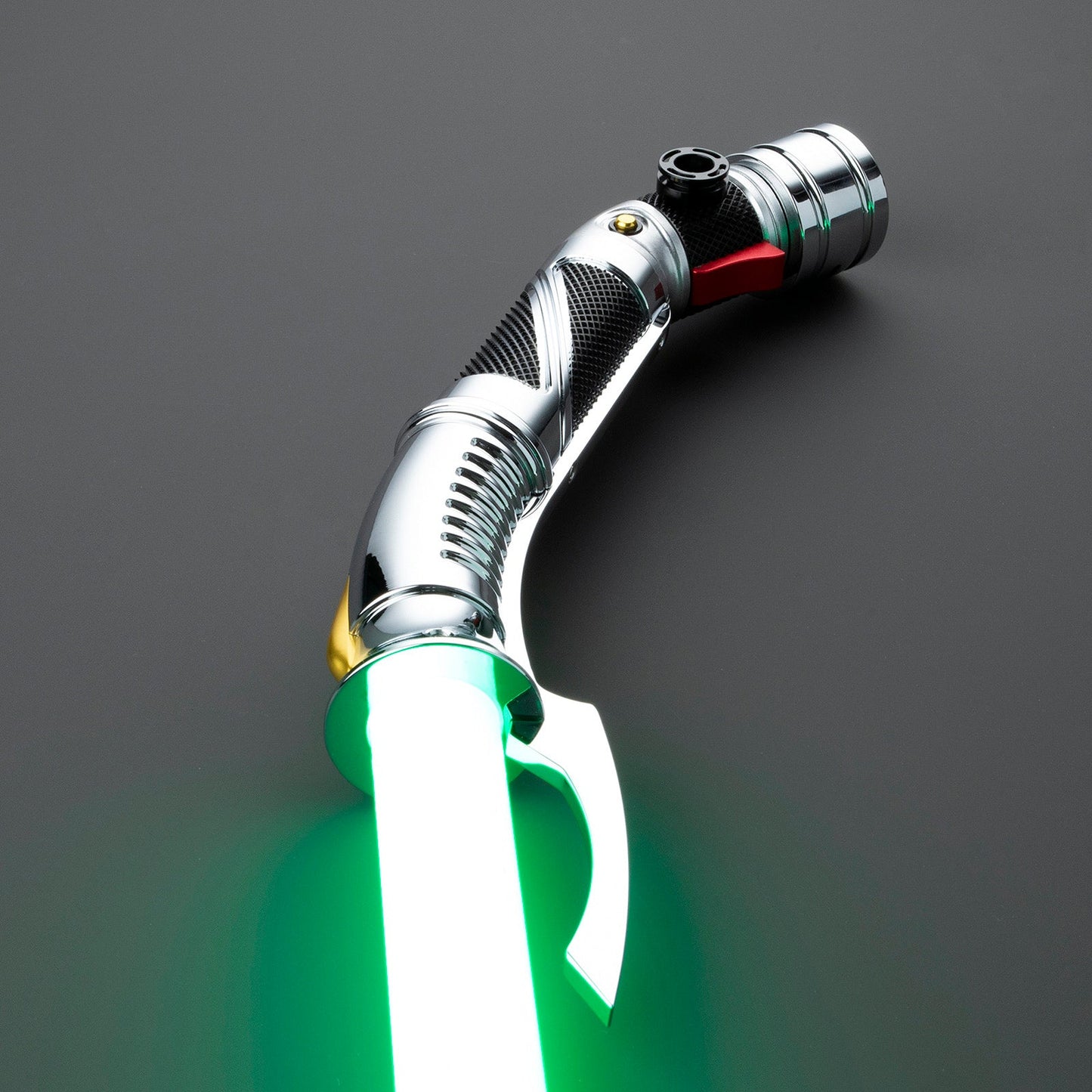
A curved hilt. That's the difference between a Dooku lightsaber and every other saber on the shelf. And it's not just for looks — the curve changes how the whole thing handles.
This is ISABER's Count Dooku replica: a 32cm machined aluminum alloy hilt with the forward curve made famous in Attack of the Clones and Revenge of the Sith. Available in Xenopixel V3 and Proffie 2.2, with a Neopixel blade in 28", 32", or 36".
Why is a curved hilt a big deal? Because most "Dooku" sabers out there aren't curved at all. They're straight tubes with Dooku-themed styling. That's not a Dooku saber. That's a Vader saber with a different paint job. A real curved hilt takes roughly 3× longer to machine. Most sellers skip it. This one doesn't.
ISABER is not associated with Lucasfilm or Disney. This is a sabersmith-built replica for dueling, cosplay, or display.
What Are the Specifications?
| Specification | Details |
|---|---|
| Character | Count Dooku / Darth Tyranus (Episodes II & III) |
| Hilt Design | Curved hilt (forward-canted grip), machined aluminum alloy |
| Hilt Length | 32cm |
| Hilt Material | Aluminum alloy with textured grip section |
| Blade Type | Neopixel LED strip (50W), 1-inch diameter, 3mm polycarbonate |
| Blade Length Options | 28" (72cm) / 32" (82cm) / 36" (92cm) |
| Soundboard | Xenopixel V3 or Proffie 2.2 |
| Sound Fonts | 34 pre-installed (Xenopixel); 16–35, unlimited via SD card (Proffie) |
| Bluetooth | Yes (Xenopixel V3 app); No (Proffie 2.2) |
| Blade Effects | 9 modes (Xenopixel): Stable, Pulse, Unstable, Ghost, Candy, Rainbow, Cracked, Fire, Flash; Fully programmable (Proffie) |
| Ignition Styles | 7 preset (Xenopixel); Unlimited custom (Proffie) |
| Battery | 3600mAh 18650 rechargeable (built-in) |
| Battery Life | ~2–3 hours (Neopixel), varies by brightness and blade effects |
| Charging | USB Type-C (~3 hours to full) |
| Gesture Controls | Tip drag, stab, melt, blaster deflection, lock-up (Xenopixel); Fully configurable (Proffie) |
| Weight | ~4,000g (with blade) |
| Speaker | 3W bass speaker |
| SD Card | 32GB included (Xenopixel); 16GB included (Proffie) |
Soundboard Options
Two boards. Same Neopixel blade. Very different experience.
Xenopixel V3 — For most people
This is the one you want if you want to open the box and start dueling tonight.
- 34 pre-installed sound fonts on a 32GB SD card
- Bluetooth app (iOS & Android) — change colors, effects, fonts from your phone
- 9 blade effects: Stable, Pulse, Unstable, Ghost, Candy, Rainbow, Cracked, Fire, Flash
- 7 ignition styles + full gesture controls, all out of the box
- No programming. No config files. No Arduino.
Proffie 2.2 — For the tinkerer
This is the one you want if editing config files sounds like fun. And for some people, it absolutely is.
- Open-source firmware — unlimited blade style customization
- Design your own ignition animations from scratch. Mix custom sound fonts. Tweak every RGB value, every timing parameter, every motion profile.
- 16–35 pre-installed fonts on a 16GB SD card, unlimited via expansion
- No app, no presets. You edit text files on the SD card. Arduino IDE for firmware.
Never touched Arduino? Go Xenopixel. Already have a Proffie saber and love it? You know why you want another one.
Design Features
The Curved Hilt: Not a Gimmick
Let's be clear about what "curved" means here. The grip is forward-canted. When you hold it, the blade angles slightly ahead of your wrist. On a straight hilt, thrusting at a target requires a 10–15 degree wrist break. On this hilt, the blade is already pointing there. Your wrist stays neutral. The tip naturally goes where you're looking.
For one-handed Makashi fencing — Dooku's canonical Form II — this is a genuine advantage. Faster thrusts. Better point control. Less fatigue over long sessions.
But there's a tradeoff, and it's real. Curved hilts fight you during spins. The center of mass doesn't track straight through the grip, so continuous orbits feel less predictable. If your style is more Anakin than Dooku — two-handed, heavy, spinning — a straight hilt is the better tool. If you fight one-handed with an emphasis on precision, the curve works with you.
Machined Aluminum Hilt
32cm of aluminum alloy. Textured grip section. The iconic flared emitter shroud. It looks the part.
The thing most people don't know: a curved profile takes 3× longer to machine on a 5-axis CNC than a straight tube. That's the bottleneck. That's why most budget Dooku sabers are straight tubes with Dooku stickers. This one is machined curved, the hard way.
One thing to know: the grip runs thick. Dooku replicas are known for having a fuller hand-feel than straight-hilt sabers of the same length. The pommel is counterweighted to balance the curved neck, so the center of mass sits just behind the emitter. If you have smaller hands, the grip might feel substantial during long sessions.
Neopixel Blade
A 50W Neopixel LED strip runs the full length of the polycarbonate blade. Rich red. Even from base to tip. No dark spots. The scrolling ignition is smooth — you see the blade come alive from emitter to tip, like in the films.
On Xenopixel, effects like Unstable and Pulse give the red blade a crackling, barely-contained energy. It suits a Sith Lord.
Dueling? The 3mm polycarbonate handles light to medium contact without issue. Full-contact heavy sparring is a different story — the LED strip inside can crack from hard impacts. Blade replacements run $40–60. For cosplay, staged duels, and backyard practice, this blade will hold up for years.
Who Was Count Dooku — and Why Does His Lightsaber Matter?
Count Dooku — also known as Darth Tyranus — was one of the best duelists in Star Wars. Period. Trained by Yoda himself. A Jedi Master who walked away from the Order, became the political leader of the Separatists, and took his place as Darth Sidious's second apprentice after Darth Maul.
His dueling record:
- Geonosis (Attack of the Clones) — Beat Obi-Wan and Anakin back-to-back. Then held his own against Yoda.
- The Clone Wars — Trained Asajj Ventress, Savage Opress, and briefly General Grievous in lightsaber combat.
- Invisible Hand (Revenge of the Sith) — The final fight. Anakin disarmed him — literally, both hands — before Palpatine ordered his execution.
In every single one of these fights, Dooku used the same curved-hilt design. He didn't choose the curve because it looked cool. He chose it because it matched how he fought.
Dooku was a master of Makashi — Form II of the seven classical lightsaber combat forms. Makashi is basically fencing with a lightsaber. Economy of motion. Point control. Precise blade work. A curved hilt makes all of that easier. More on that in a moment.
And the red blade? That came later. As a Jedi, Dooku carried blue. After falling to the Sith, he performed the ritual of bleeding a kyber crystal — pouring rage and dark side energy into a captured crystal until it turned crimson. A saber that starts blue and turns red carries its wielder's story in the blade itself.
Dooku's Fighting Style: Makashi, the Duelist's Form
Seven classical lightsaber combat forms in Star Wars. Most Jedi mastered one or two. Dooku mastered Makashi (Form II) — and everything about his saber was built around it.
What Makes Makashi Different
Most forms — Soresu (III), Djem So (V) — were built for the battlefield. Deflecting blaster bolts. Fighting multiple enemies. Makashi was different. It was built for one thing: lightsaber-on-lightsaber dueling.
- Sideways stance. Narrow target. Hard to hit.
- Tight footwork. Strikes from the wrist, not the shoulder.
- Finesse over power. The goal is to land first, not land hardest.
And that's why Dooku fights nothing like Anakin. Anakin uses Djem So (Form V) — heavy, two-handed, meant to overwhelm. Dooku uses Makashi — quick, one-handed, economical. When they fight in Revenge of the Sith, you're watching two completely opposite philosophies collide. The curved hilt is the physical expression of that difference.
Why the Curve Matters
On a straight hilt: thrust at a target, you have to flex your wrist. Do that for an hour and your wrist feels it. On a curved hilt: the blade is already angled forward. Your wrist stays neutral the whole time. Faster thrusts. Better point control. Way less fatigue.
But — and this matters — curved hilts fight you during spins. The center of mass doesn't track straight through the grip, so continuous orbits feel unpredictable. Dooku, a Makashi purist, didn't spin. He thrust, parried, and disengaged. The hilt was built for exactly that.
How Dooku's Lightsaber Compares to Other Iconic Sabers
| Character | Hilt Shape | Combat Form | Fighting Style | Best For |
|---|---|---|---|---|
| Count Dooku | Curved | Makashi (Form II) | One-handed, precision dueling | Fencing-style combat, point control |
| Darth Vader | Straight, heavy | Djem So (Form V) | Two-handed, overwhelming power | Dominant dueling, presence |
| Darth Maul | Straight, double-blade | Juyo (Form VII) | Aggressive, spinning offense | Multiple opponents, flow arts |
| Anakin Skywalker | Straight, Graflex | Djem So (Form V) | Two-handed, athletic power | Aggressive dueling |
| Obi-Wan Kenobi | Straight, thin-neck | Soresu (Form III) | Defensive, efficient | Defensive dueling, endurance |
| Kylo Ren | Straight, crossguard | Unorthodox/self-taught | Heavy, raw power | Crossguard aesthetic |
| Luke Skywalker | Straight, Graflex/ROTJ | Djem So/self-taught | Raw to refined | Classic hero display |
Here's the thing about this comparison.
Every saber on this list is a straight hilt. Buy a Vader. Buy an Anakin. You're buying the look. The handling? Same as any other straight-hilt saber.
But Dooku's is different. It's the only one where the hilt shape changes how the weapon handles. You're buying the look and a totally different handling experience. That's not cosmetics. That's a meaningful choice.
Visually, it stands apart too. In a lineup of straight hilts, the curved Dooku is the first one people notice. A conversation piece.
Behind the Scenes: Christopher Lee and the Curved Hilt
The curved lightsaber wasn't some concept artist's idea. Christopher Lee drove it.
Lee was a genuine fencer — he held the record for the most on-screen sword fights in cinema history at the time. When George Lucas showed him the initial saber designs, Lee said no. He wanted a curved grip. He knew from decades of fencing that a curved hilt would let him fight with proper form: one-handed thrusts, tight parries, elegant footwork. Not the wide two-handed baseball swings most lightsaber choreography relied on.
He was 78 years old during Attack of the Clones and still did much of his own choreography, with stunt double Kyle Rowling handling the hardest sequences. The curved hilt was built to his specifications. One of the few lightsaber designs in Star Wars driven by an actor's real martial expertise.
He also voiced Dooku in The Clone Wars, extending the character beyond the films. And you can see it on screen: he handles the weapon naturally because the weapon was literally designed for him.
When Should You Choose (and NOT Choose) the Count Dooku Lightsaber?
Get this saber if:
- You want an actual curved hilt, not a straight-hilt "Dooku SE." Most budget Dooku sabers ($200–$400) use a straight hilt with Dooku-themed cosmetics. They're fine sabers for the price, but they don't handle like a Dooku. The curve is the most expensive part to manufacture and the one feature that defines the character's saber. If the curve matters to you, this is one of the few production-volume options available.
- You practice one-handed Makashi / fencing-style dueling. The forward cant aligns the blade with your forearm during thrusts. For point control, precision parries, and the kind of elegant single-strike offense Dooku favored, the curve is a genuine advantage over a straight hilt.
- You're cosplaying Count Dooku and screen accuracy matters. The curved profile is unmistakable — visible from across a convention hall. On a belt, in hand, or in photos, you can tell a real Dooku from a straight-hilt stand-in at a glance.
- You collect character replicas and the Dooku is missing from your shelf. The included display stand and premium case make it shelf-ready. In a lineup of straight hilts, the curved Dooku is the one people pick up first.
Skip this saber if:
- You primarily spin, trick, or fight two-handed. Curved hilts fight spins. The rotational balance is fundamentally different from a straight hilt, and the center of mass doesn't track along a straight axis during orbits. Experienced spinners can adapt, but if spinning and flow arts are your thing, a straight hilt is the better tool.
- You have smaller hands. Even in the community, the Dooku hilt's grip diameter is consistently noted as thicker than average. If you find standard straight hilts comfortable but not generous, the Dooku will be fine. If standard hilts already feel large, try a Dooku in person before buying.
- You do heavy full-contact dueling. Neopixel blades — Xenopixel or Proffie — are rated for light to medium contact. The LED strip inside can fracture from hard impacts. For full-contact sparring, you want a Baselit (hilt-lit) saber where the LED is in the hilt and the blade is a plain polycarbonate tube that's cheap to replace. This Dooku model does not come in a Baselit version.
- Your budget is under $400. At $733–$790, this is a premium replica. The machining cost on the curved hilt means it will never compete on price with a straight-hilt saber. If budget is the primary constraint, a straight-hilt "Dooku SE" gets you the same Xenopixel V3 electronics for roughly half the price — you lose the curve but keep the sound and light experience.
What's in the Box?
- Count Dooku machined aluminum curved hilt with installed soundboard and rechargeable battery
- 1-inch Neopixel polycarbonate blade (your choice: 28", 32", or 36")
- USB Type-C charging cable
- Display stand
- Blade plug (for displaying the hilt without the blade)
- Allen key and spare screw set
- User manual
- SD card reader (Xenopixel version only)
- Premium carrying case
Frequently Asked Questions
Q1: Does the curved hilt actually help in dueling, or is it just for looks?
A: It helps. For the right style.
If you fight one-handed — Makashi, the way Dooku fought — the curve angles the blade forward without flexing your wrist. Faster thrusts. Better point control. The difference is obvious within five minutes of handling.
If you fight two-handed, power strikes, lots of spinning? Straight hilt is better. The curve optimizes for a specific approach. It's not neutral.
Q2: Which soundboard should I choose — Xenopixel V3 or Proffie 2.2?
A: Xenopixel V3 if you want to duel tonight. 34 fonts. Bluetooth app. Nine blade effects. Everything works out of the box.
Proffie 2.2 if editing config files sounds like a good evening. Unlimited customization. Design your own ignition animations from scratch. But you'll live in Arduino IDE.
Never touched Arduino? Go Xenopixel. Already own a Proffie and love it? You already know.
Q3: Which blade length should I pick — 28", 32", or 36"?
A: 32" (82cm) is the sweet spot for one-handed Makashi. Long enough for reach, short enough for fast point transitions.
36" gives maximum reach but the longer lever arm makes the curved hilt feel tip-heavy. 28" is fastest — best for small spaces and close-quarters. All three same price. Pick by your arm length and fighting style.
Q4: Can I use this for heavy dueling?
A: No. Neopixel blades have an LED strip inside that can fracture from hard impacts. They're rated for light to medium contact: cosplay sparring, choreographed duels, backyard practice.
For full-contact competitive dueling, you want a Baselit saber — LED in the hilt, plain polycarbonate blade, cheap to replace. This Dooku model doesn't come in Baselit.
Q5: Is this the same as the "Dooku SE" from other sellers?
A: No. "Dooku SE" sabers are straight hilts with Dooku-themed styling. The electronics inside are often the same Xenopixel V3. The sound and light experience is similar.
But there's no curve. And the curve is the most expensive feature to manufacture — which is exactly why the budget versions skip it. If you just want a red Sith saber with Dooku branding, SE is fine. If you want a Dooku that actually handles like a Dooku, the curve is the whole point.
Q6: How does the curved hilt affect spinning and tricks?
A: Poorly. The curve changes rotational balance — the center of mass doesn't track straight through the grip, so continuous orbits feel unpredictable. Skilled spinners can adapt, but if flow arts are your primary thing, a straight hilt is objectively better. The Dooku hilt is built for fencing. Not juggling.
Q7: What if I have smaller hands — will the grip be too thick?
A: The Dooku grip is thicker than a standard straight hilt. It's one of the first things people notice. If standard hilts (Anakin, Luke) feel comfortable, the Dooku should be fine — fuller in hand, but manageable. If standard hilts already feel large, or you wear small gloves, try before buying.
Q8: How does this compare to the Hasbro Force FX Dooku?
A: Three differences that matter:
- Blade: Hasbro = fixed, can't remove, breaks = whole thing done. ISABER = removable, standard 1-inch retention, replaceable.
- LED: Hasbro = older string-blade, known dead-pixel issues. ISABER = 50W Neopixel strip, rated light-to-medium contact.
- Customization: Hasbro = preset sounds and colors, zero flexibility. ISABER = full RGB control, Bluetooth app or Arduino-based font management.
The Hasbro is a collectible. The ISABER is a dueling saber that also looks great on display.
Q9: How long does the battery last, and can I replace it?
A: 2–3 hours on a full charge at typical brightness. Heavy effects and max volume pull that toward 2. USB-C charges to full in ~3 hours.
Battery is built-in. Replaceable if needed, but not hot-swappable mid-session. For all-day conventions, charge overnight. For extended dueling, a USB-C power bank does the job.
Q10: What's the warranty?
A: 30 days on hilt and electronics for manufacturing defects. The Neopixel blade is covered DOA (dead on arrival) but not against dueling damage — blades are consumable in this hobby. Soundboard fails, battery dies, hilt arrives with a defect: contact us with your order number. Replacement within 48 hours.
Q11: Why did Count Dooku use a curved lightsaber in the first place?
A: Practical choice for Makashi (Form II) — his fencing-based dueling form. A curved hilt angles the blade forward without wrist flexion. Faster thrusts. Better point control. Less fatigue.
The design traces to real curved-grip fencing weapons like the French grip in epee. Point control over power.
It also fit who he was: Count of Serenno, aristocrat, a refined duelist who treated combat as an art form. A custom, elegant weapon for a man who saw himself as above the Jedi Order's utilitarian approach.
Q12: Was Dooku's lightsaber always red?
A: No. As a Jedi, Dooku carried blue. You can see it in Tales of the Jedi. After becoming Darth Tyranus, he bled a kyber crystal — the Sith ritual of pouring dark side energy into a captured crystal until it turns crimson.
The ISABER Dooku comes default red. But on Xenopixel or Proffie, you switch to any color in seconds — including the Jedi blue he once carried.
Q13: Is Count Dooku's lightsaber the only curved one in Star Wars?
A: It's the most famous — and the most authentic. Christopher Lee, an actual fencer, requested the curved hilt so he could fight with proper form. One of the few saber designs driven by real martial expertise, not the art department.
Ventress had slightly angled paired sabers. Some Old Republic Sith used curves. But Dooku's remains the definitive curved lightsaber in Star Wars.
Q14: What happened to Dooku's lightsaber after Revenge of the Sith?
A: Taken by Anakin after their duel aboard the Invisible Hand, right before Dooku's execution. Its ultimate fate in canon is ambiguous. In Legends, it joined the Jedi Temple memorial collection before the temple fell. Either way: the ISABER replica carries the legacy of one of the last true Makashi masters.
Q15: Does the ISABER Dooku come with a display case?
A: Yes. Every ISABER Dooku includes:
- Premium carrying and display case
- Dedicated display stand (for hilt-only display)
- Blade plug (protects the emitter)
Included with both Xenopixel V3 and Proffie 2.2. Arrives shelf-ready.
- Premium carrying and display case
- Dedicated display stand (for hilt-only display)
- Blade plug (to protect the emitter)
Included with both Xenopixel V3 and Proffie 2.2. The Dooku arrives shelf-ready.
Share


WHY ISABERS
-
Affordable Prices
We are proud to make cosplay affordable and realistic!
-
Faster Shipping
Parcels will be shipped within 24 hours, much faster than Amazon Prime!
-
Easier Returns
For every eligible items returned, we do not charge any restocking fees!
-
Trusted By More Users
You can see the recognition of our users from our reviews.
Product Details
-
RGB&Baselit
Functions
- Gesture control
- Duel ready
- Flash on clash
- Blaster block
- Removable blade
- Smooth swing
- Multiple Colours
Features
- 2mm Polycarbonate blade
- 12w RGB LED
- Bluetooth enabled
- Safety protected 18650 3000mAh 3.7v Battery
- SD card that you can add and remove sound fonts
- over 30 sound fonts pre installed
- Blade styles (unstable, stable and pulse)
Included in The Parcel
- Saber Hilt *1
- Polycarbonate Blade *1
- USB Charger *1
- Hex Wrench and Screw Set *1
-
Xenopixel
Functions
- Gesture control
- Duel Ready
- Flash on clash
- Blaster block
- Removable blade
- Smooth swing
- Multiple Colors
Features
- 3mm Polycarbonate Neo blade
- 50w LGT RGB Neopixel strip
- Bluetooth enabled
- Safety protected 18650 3600mAh 3.7v Battery
- SD card that you can add and remove fonts
- Over 30 sound fonts pre installed
- Blade styles (rainbow, candy, fire, unstable, cracked and more)
- 10 different ignition styles including blaster mode
Included in The Parcel
- Saber Hilt *1
- Polycarbonate Blade *1
- USB Charger *1
- Hex Wrench and Screw Set *1
-
Proffie
Fuctions
- Duel Ready
- Flash on clash
- Blaster block
- Removable blade
- Smooth swing
- Multiple Colours
Features
- 3mm Polycarbonate Neo Blade
- 50w LGT Neopixel blade
- Safety protected 18650 3600mAh 3.7v Battery
- SD card that you can add and remove fonts
- Over 20 sound fonts pre installed
- Completely programmable board regarded as the best on the market
Included in The Parcel
- Saber Hilt *1
- Polycarbonate Blade *1
- USB Charger *1
- Hex Wrench and Screw Set *1