
Why Sith Lightsabers Are Red: The Kyber Crystal Bleeding Ritual Explained
Red lightsabers aren't manufactured. They're made — by breaking something that was once aligned with the light. Every crimson Sith blade you've ever seen started as a Jedi's crystal. Blue, green, purple, yellow — doesn't matter. A dark side user took it, poured their rage and pain into it, and corrupted it until it bled red. This isn't metaphorical. It's a Force ritual called "bleeding," and it's one of the most significant lore additions of the Disney-era Star Wars canon.
And the reverse is possible too. A bled crystal can be healed — purified back from red to white — by someone who understands the pain that corrupted it in the first place. Ahsoka Tano did it. Her white blades aren't just a color choice. They're proof that kyber crystals can be saved, just like people. Here's how both rituals work, what they mean, and why they matter for anyone who cares about lightsabers beyond the glow.
The Bleeding Ritual: How a Jedi Crystal Becomes a Sith Blade
In the old Expanded Universe (Legends), Sith lightsabers used synthetic crystals — artificially grown, infused with dark side energy during the forging process. It was neat and tidy. You want a red saber? You make a red crystal. The new canon, established in E.K. Johnston's 2016 novel Ahsoka and first depicted visually in Marvel's Darth Vader: Dark Lord of the Sith #5 (2017), replaced synthetic crystals with something darker.
Kyber crystals are naturally attuned to the light side of the Force. They're not neutral. They're not blank slates. They are, for all practical purposes, living entities that resonate with the light. A Sith can't just pick one up and use it — the crystal resists. Darth Sidious's instruction to Vader, recorded in the Darth Vader comic, is the clearest description we have:
"Corrupt the kyber crystal. Teach it your pain. Teach it your anger. Hear it sing a hymn of darkness. Make it bleed."
The Sith pours every negative emotion — rage, hatred, fear, grief, pain — into the crystal through the dark side. The crystal fights back. Vader experienced intense Force visions during his bleeding ritual on Mustafar: images of himself returning to the light, destroying the Emperor, being reunited with Obi-Wan. The crystal showed him what he was giving up. His resolve nearly broke. But he pushed through, and the crystal turned red.
This is why the Sith tradition says "the saber of a Sith is not given, it is taken." A Sith is supposed to kill a Jedi and claim their crystal. Bleeding a murdered Jedi's crystal is a ritual of domination — you're not just killing the Jedi, you're corrupting the thing they built their identity around.
Kylo Ren and the Cracked Crystal
Ben Solo's bleeding ritual went wrong. He poured too much into it.
In the canon comic miniseries Star Wars: The Rise of Kylo Ren by Charles Soule, Ben — freshly fallen, having just killed his fellow students and the leader of the Knights of Ren — attempts to bleed the blue kyber crystal from his Jedi lightsaber. He clenches his fist. Images of Han Solo, Leia, and Luke flood his mind. His pain regarding his family is the fuel. But he overdoes it. The crystal doesn't just turn red — it cracks.
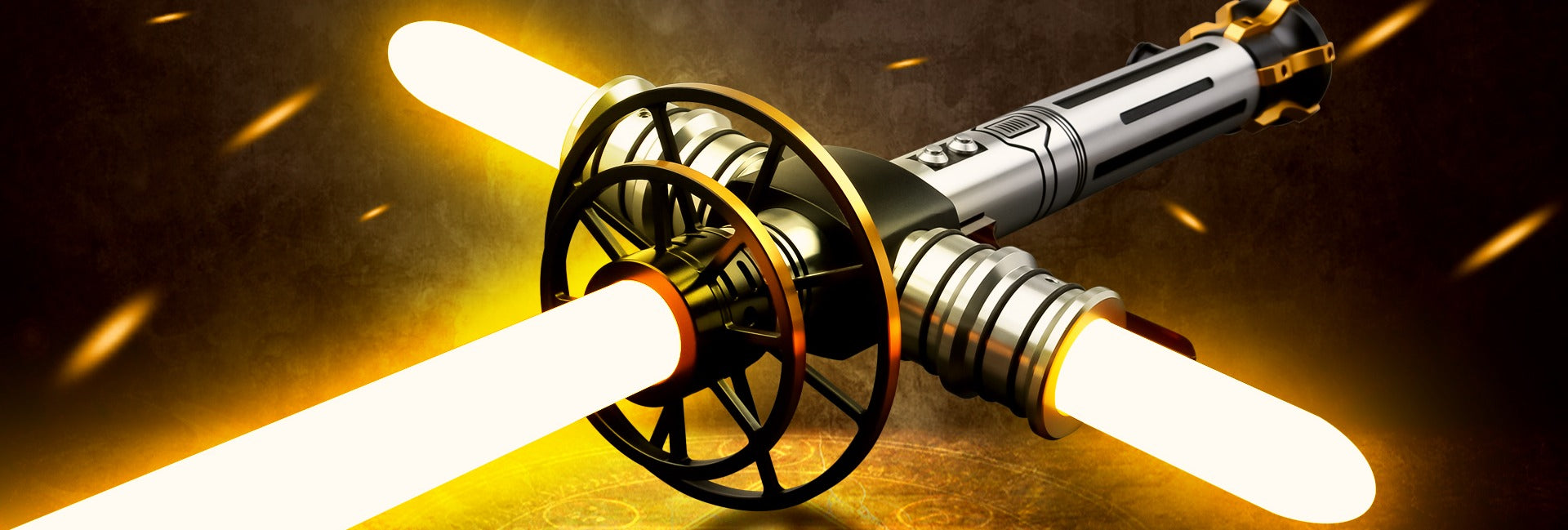
A cracked kyber crystal produces unstable, unregulated energy. When Ben reassembles the hilt with the damaged crystal, it shorts out and threatens to overload. His solution: retrofit twin crossguard vents (quillons) to bleed off the excess energy as side blades. The iconic unstable, crackling, sparking red blade of Kylo Ren's crossguard saber is a direct physical consequence of a bleeding ritual performed with too much raw emotion and not enough control.
That's the tragedy built into the hilt. The crossguard isn't a design choice. It's a repair. The unstable blade isn't an aesthetic. It's a wound that won't heal. Kylo Ren's lightsaber is the most honest weapon in Star Wars — it shows exactly what he is: cracked, unstable, held together by modifications that only barely prevent total failure.
And then, in The Rise of Skywalker, on the ocean moon of Kef Bir, after a vision of his father, he throws it into the sea. The crackling red blade extinguishes underwater. He walks away as Ben Solo. The weapon that embodied his fractured soul is gone.
Purification: Healing a Bled Crystal
If bleeding is corruption, purification is healing. A light-side user can reverse the process — not by dominating the crystal the way a Sith does, but by understanding and releasing the pain that was poured into it.
The ritual was first described in the Ahsoka novel and formally named in The High Republic: Light of the Jedi. The user must attune to the crystal, feel the suffering of the dark sider who originally bled it, and then infuse it with positive emotions — compassion, hope, joy — to neutralize the negative energy. A successfully purified crystal doesn't return to its original color. It turns white.
Ahsoka Tano is the most famous example. After leaving the Jedi Order, she defeated an Inquisitor known as the Sixth Brother and claimed his two bled crystals. She purified them. Her white blades — seen in Star Wars Rebels, The Mandalorian, and her own series — are the visual signature of someone who walks between light and dark. Not a Jedi. Not a Sith. A purified crystal wielder who understands both sides.
The white blade carries specific meaning in the saber community. It's the color of independence. Of someone who's seen the dark side up close and chosen the light not out of obligation but out of understanding. If a blue saber says "I am a Jedi," a white saber says "I know what I'm fighting for."
What This Means For Your Saber Collection
The bleeding and purification lore changes how you look at lightsaber colors. Red isn't just "the bad guy color." It's a crystal that's been tortured. Blue isn't just "the good guy color." It's a crystal that's never been broken. White isn't just a rarity. It's a crystal that was broken and chosen to heal.
When you display a Kylo Ren crossguard next to a Ben Solo single-blade — same hilt, different points in its life — you're not just showing two sabers. You're showing a character's entire arc. The Jedi apprentice. The fall. The cracked crystal. The crossguard modification. The abandonment of the red blade. The redemption.
And if you add an Ahsoka white-blade to that display, you've got the third beat: proof that corruption isn't permanent. That what was bled can be healed. That's not just lightsaber collecting. That's storytelling with hardware.
The Colors and What They Actually Mean
| Color | Canon Meaning | How It's Made |
|---|---|---|
| Blue | Jedi Guardian — combat focus, physical defense | Natural kyber, attuned by a Jedi |
| Green | Jedi Consular — wisdom, diplomacy, Force focus | Natural kyber, attuned by a Jedi |
| Red | Sith / dark side — domination, rage, corrupted | Bled: light-side crystal corrupted by dark side ritual |
| White | Neutral / independent — purification, balance | Purified: bled crystal healed by light-side compassion |
| Purple | Jedi who walks the line — light side with darkness understood | Natural kyber; Mace Windu is the only canon example |
| Yellow | Jedi Sentinel — balance of combat and scholarly pursuits | Natural kyber; Temple Guards and Rey's final saber |
| Orange | Rare; associated with ambiguous alignment | Canon examples are sparse; Cal Kestis can use it in-game |
| Black (Darksaber) | Mandalorian leadership — not a kyber crystal weapon | Unique: stolen from the Jedi Temple over 1,000 years ago by Tarre Vizsla |
The kyber crystal doesn't care about your favorite color. It cares about what you've done to it. That's the difference between picking a blade color in an app and understanding what the color actually means in-universe. The app lets you choose any color. The lore explains why most Force users don't.
Next time you hold a red-bladed saber — even a replica — remember what it represents. That red blade was blue once. Someone broke it. And someone else, somewhere, could heal it.