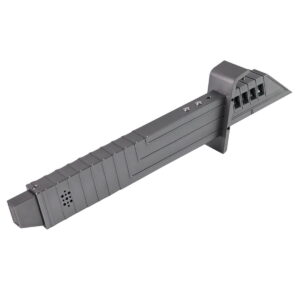
A black lightsaber is the Darksaber — the only one canon has ever shown. Its blade is flat and sword-shaped rather than a round beam, and it was built over a thousand years ago by the only Mandalorian ever taken into the Jedi Order.
Canon has never explained why the blade is black. The weapon also no longer exists, and the widely repeated claim that it contains no crystal is wrong.
Most of what circulates about the black blade mixes three different sources: what appeared on screen, what a licensed reference guidebook states, and what fans have proposed to fill the gaps. Those three carry very different weight, and the confusion between them is why so many explanations contradict each other.
That distinction is the spine of this page.
It covers the blade’s form, why it is the only one of its kind, what canon does and does not say about the color, the weight rule that makes it behave unlike any other weapon, its lineage, and how it ended.
Two claims made in older write-ups are corrected below: that the hilt contains no crystal, and that the weapon is being carried today. Neither holds.
What’s on This Page
- What the Black Blade Actually Is
- The Only One in Canon
- What Canon Explains About the Color
- Why the Blade Grows Heavier
- A Thousand-Year Lineage
- How the Darksaber Was Destroyed
- Black Blades in the Old Continuity
- Frequently Asked Questions
What the Black Blade Actually Is
The Darksaber’s blade is flat and sword-shaped rather than a cylindrical beam, noticeably shorter than a standard lightsaber blade, and outlined by a thin crackling white edge. The shape separates it from every other lightsaber before the color does.
Every other lightsaber produces a round blade with no edge orientation. The Darksaber produces a flat one, so it has a distinct up and down, like a sword.
The hilt follows the same logic. It ends in a curved, tapered point rather than a flat cap, and the grip is shorter than most lightsaber handles.
That combination is why the weapon is often described as resembling a sword rather than a saber — and the description is about the geometry, not about the blade being sharp in the way a metal sword is.
| Property | Darksaber | Standard lightsaber |
|---|---|---|
| Blade cross-section | Flat, sword-like | Round cylindrical beam |
| Blade length | Shorter than standard | Longer, consistent |
| Edge | Crackling white outline | Even glow, no edge |
| Hilt end | Curved, tapered point | Flat cap |
| Grip length | Shorter than most | Standard |
| Weight behaviour | Changes with the wielder’s state of mind | Constant |
The Only One in Canon
Canon contains exactly one black blade and it is a single bespoke weapon, not a color that occurs. No black kyber crystal has ever been shown, and there is no route by which a person could end up with a black blade.
This is a structural difference from every other color. Blue and green are described as what a fresh crystal takes on when it bonds with a light side user. Red and white come from acts performed on a crystal.
Black belongs to neither category. It is a property of one specific weapon built by one specific person over a thousand years before the events of the films.
Which means the common phrasing — “a black lightsaber” — is slightly misleading. There is no class of black lightsabers. There is the Darksaber, and there is nothing else.
What Canon Explains About the Color
Canon does not explain why the blade is black. It does establish that the hilt holds a crystal at its core, which rules out the widely repeated claim that the weapon is built from beskar instead of a crystal.
That beskar idea is a fan theory with no canon support behind it.
The on-screen record is thin in a specific way. The crystal inside the Darksaber is only ever referred to loosely, not identified by type.
A licensed reference guidebook goes further and states the weapon has a kyber crystal core. That is a secondary source, but it is the strongest statement available and it directly contradicts the no-crystal claim.
What remains genuinely unexplained is the color itself. Nothing in canon accounts for a black blade.
The most coherent inference is that the crystal is an unusual one.
The lightsabers of the prequel era are uniform because their crystals came from a single world, and no black crystal has ever been associated with that world. That suggests the Darksaber’s crystal came from somewhere else entirely — an inference, not a statement.
The three claims on the right circulate as established lore. None of them are sourced, and the middle one is contradicted by the guidebook statement on the left.
Why the Blade Grows Heavier
The Darksaber becomes heavier to hold when the person wielding it lacks conviction. The explanation given in canon is that the wielder’s own thoughts and emotions are drawn into the blade’s energy, and inner conflict registers as added weight. No other lightsaber behaves this way.
This is the weapon’s most distinctive property and the one most often left out of descriptions that focus on appearance.
It is not a physical malfunction. The blade does not change mass. What changes is how heavy it feels to the person holding it.
The practical consequence is that the Darksaber is a test as much as a weapon. Someone who takes it up reluctantly finds it unwieldy; someone settled in their intent finds it manageable.
Several characters across the series are shown struggling with it for exactly this reason, and the struggle is treated as a character beat rather than a mechanical detail.
A Thousand-Year Lineage
The Darksaber was built by the only Mandalorian ever accepted into the Jedi Order. After his death it was kept in the Jedi Temple, then taken by his own clan, and from then on it changed hands mainly by combat.
Mandalorian tradition held that the blade could only be won by defeating whoever carried it.
That rule is what turned a weapon into a constitutional question. Holding the Darksaber became a claim to lead Mandalore.
Which is also why the blade’s history is a list of conflicts rather than a list of owners. Almost every transfer was contested.
| Holder | Period | How it changed hands |
|---|---|---|
| Tarre Vizsla | A thousand-plus years before the films | Built it; the only Mandalorian Jedi |
| The Jedi Temple | After his death | Kept there until House Vizsla took it |
| House Vizsla | Centuries | Used its claim to rule Mandalore |
| Pre Vizsla | Clone Wars era | Led the splinter group that broke from Mandalore’s pacifist government |
| Darth Maul | Clone Wars era | Defeated Pre Vizsla in combat |
| Sabine Wren | Imperial era | Recovered it and later tried to pass it on |
| Moff Gideon | After the Empire | Obtained it outside the tradition |
| Din Djarin | New Republic era | Won it from Gideon in combat |
| Bo-Katan Kryze | New Republic era | Accepted it, then lost it in battle |
One detail in that list matters more than the rest. Several holders tried to give the blade away and found it could not simply be handed over — the tradition required winning it, and refusing it was itself a meaningful act.
So the lineage is not a clean succession. It is a record of people taking it, refusing it, and being unable to keep it.
How the Darksaber Was Destroyed
The Darksaber no longer exists. In the third season finale of The Mandalorian it was taken from Bo-Katan Kryze during a duel and crushed, shattering the blade. It was the last black lightsaber in canon, and Mandalore’s leadership passed to her without it.
The destruction was deliberate in narrative terms. The blade had caused centuries of conflict over who legitimately ruled, and removing it removed the object everyone was fighting over.
It also produced a genuine fan reaction, because the weapon was widely assumed to be effectively indestructible.
What followed matters for anyone reading older material. Bo-Katan became the recognized leader of Mandalore without holding the Darksaber, which breaks the link the blade had carried for a thousand years between possession and authority.
Any description stating that a character currently carries the Darksaber is out of date. There is nothing left to carry.
Black Blades in the Old Continuity
Black lightsaber blades also appear in the old continuity, but only as a player option in games, produced by a rare crystal the player can equip. Those games sit outside current canon.
The black blades in them are a separate concept from the Darksaber rather than an explanation of it.
This is where the idea of a “black kyber crystal” comes from. In that older material, a black crystal could be found and used to change a blade’s color.
Several titles built the option in, and it was framed as an exceptionally rare find rather than a normal choice.
None of that travels back into canon. A game mechanic that lets a player pick a color is a different kind of statement from a story establishing that a color exists.
Which is why the two ideas get conflated. Both are described as “black lightsabers,” and only one of them is a weapon.
Frequently Asked Questions
Q1: Does the Darksaber contain a kyber crystal?
A: Yes. Canon material is vague on screen — the crystal inside is only ever called “a crystal” rather than identified by type — but a licensed reference guidebook states the weapon has a kyber crystal core. That directly contradicts the claim that the hilt is built from beskar instead of containing a crystal. The beskar idea is a fan theory with no canon confirmation behind it.
Q2: Why is the Darksaber’s blade black?
A: Canon has never explained it. The most coherent inference is that the crystal inside is an unusual one, because lightsabers of the prequel era are uniform precisely because their crystals all came from a single world, and no black crystal has ever been associated with that world. That suggests the Darksaber’s crystal came from somewhere else — but that is reasoning from an absence, not a stated fact.
Q3: Is the Darksaber still around?
A: No. It was destroyed in the third season finale of The Mandalorian, where it was taken from Bo-Katan Kryze in a duel and crushed, shattering the blade. It had been assumed by many viewers to be indestructible, which is why the moment landed as a surprise. Afterward Bo-Katan became the recognized leader of Mandalore without holding it.
Q4: Can I get a black lightsaber of my own?
A: In canon terms, no — black is not a color a blade can end up with. Blue and green come from a crystal bonding with a light side user, and red and white come from acts performed on a crystal, but black is a property of one specific weapon. In the old continuity, black blades existed as a rare equippable crystal in several games, which is where the idea of a “black kyber crystal” originates.
Q5: Why does the Darksaber feel heavy?
A: Because the wielder’s own thoughts and emotions are drawn into the blade’s energy, so inner conflict registers as added weight. The blade does not change mass; what changes is how heavy it feels to the person holding it. When someone takes it up without conviction it becomes unwieldy, and when they are settled in their intent it is manageable. No other lightsaber behaves this way.
Q6: Who made the Darksaber?
A: Tarre Vizsla, the only Mandalorian ever accepted into the Jedi Order, over a thousand years before the events of the films. After his death the weapon was kept in the Jedi Temple until his own house took it, and it became the basis of a claim to rule Mandalore. From then on it changed hands mainly through combat, because Mandalorian tradition held it could only be won by defeating whoever carried it.
Q7: Can the Darksaber cut through anything?
A: It behaves as a lightsaber, so the same limits apply. It can cut through ordinary materials, and it cannot cut through beskar — a duel in the series shows the blade stopped by a beskar weapon. That is true of lightsabers generally rather than a property of the Darksaber. What makes the Darksaber distinctive is its shape, its weight behaviour, and its history, not a superior cutting edge.
Q8: Is the Darksaber a sword or a lightsaber?
A: It is a lightsaber whose blade is flat and sword-shaped rather than a round beam. That geometry is why it is described as resembling a sword, and it gives the blade a distinct edge orientation that a cylindrical lightsaber blade does not have. The blade is also shorter than a standard one, and the hilt ends in a curved, tapered point rather than a flat cap.